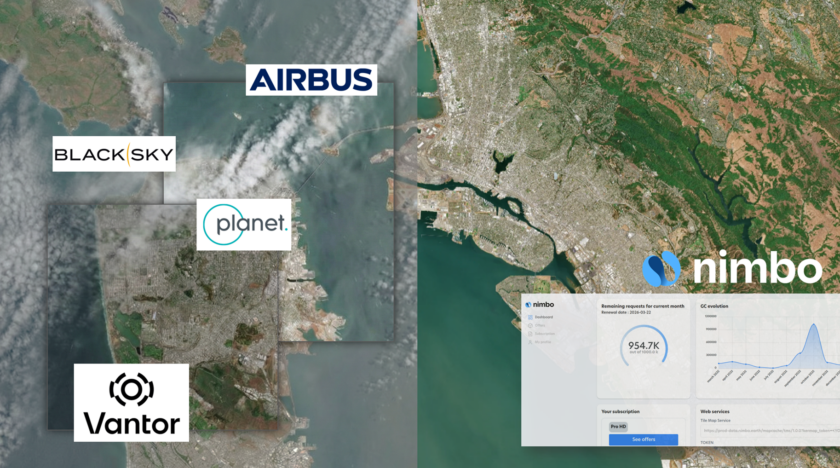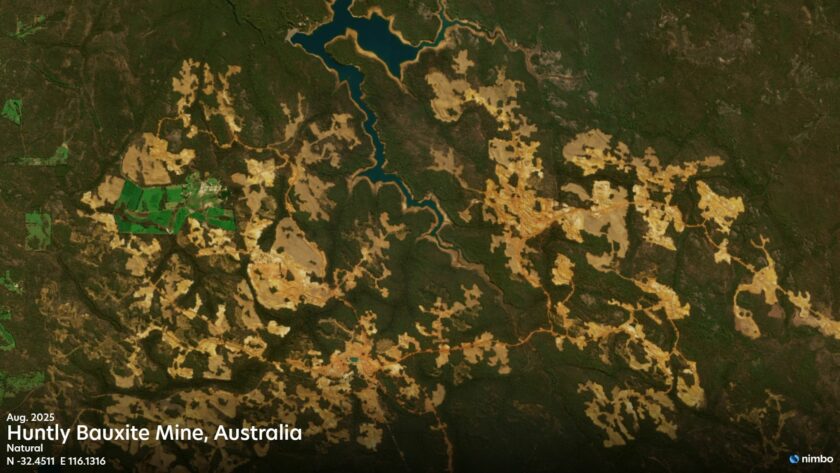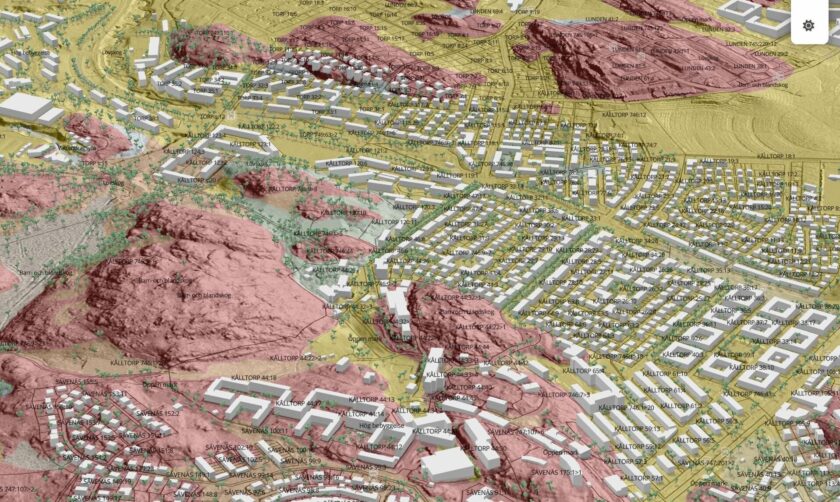



When Kermap, a French Earth Observation specialist, created Nimbo, our goal was specific: to provide the world with reliable, monthly, cloud-free, high-resolution satellite basemaps.
But as we built it, we were driven by a discomfort that went beyond technical specs.
Satellite imagery is no longer just a visual layer. It has become critical infrastructure used to guide national defence, secure critical energy assets, and monitor agricultural and environmental sustainability at a global scale.
However, as the geospatial industry is scaling rapidly, one fundamental question is almost never asked:
Where does this data actually live, who controls the servers behind the pixels, and who has the power to access the user data flowing through them?
The space digital dependency trap
The answer matters because dependency is a structural vulnerability.
Most geospatial data today flows through infrastructure controlled by a handful of non-European tech giants. While technically impressive, this creates a supply chain that is strategically fragile. When your critical data relies on external providers, you inherit their risks.
These are not just technical risks, but sovereign risks:
- Geopolitical Instability: A shift in diplomatic relations or trade disputes can restrict data access in specific regions without warning. Changes in foreign policy can sever digital supply chains overnight, regardless of your contract.
- Commercial Volatility: Providers can unilaterally deprecate APIs, change pricing models, or alter service terms to suit their financial objectives, not yours. You are renting a service, not owning a capability.
- Legal Exposure: Data stored under foreign jurisdictions is often subject to laws that prioritize their national interests over your operational continuity. Your data privacy exists only as long as it does not conflict with their intelligence requirements.
If your product relies on a feed that can be monitored or terminated without your consent, you are building on a leased vulnerability.
This is why we built Nimbo for sovereignty from the ground up. Architecting for this independence is imperative. It was the only way to ensure resilience against outages and maintain absolute control over our critical digital infrastructure.
Jurisdiction: the foundation of data sovereignty
Control starts with the law. As a French entity operating entirely under the EU jurisdiction, Nimbo is protected by a legal shield that is both transparent and uncompromising. This foundation protects three critical layers:
- Our Infrastructure: Our servers are hosted in France. This means they are immune to extraterritorial laws like the US CLOUD Act.
- Your Data: The imagery and analytics you access are governed exclusively by European laws. There are no backdoors for foreign intelligence agencies to scan your proprietary information.
- Your Privacy: We operate under the EU’s GDPR. This guarantees that your team’s activity and your strategic intent remain private.
Sovereignty is an architecture: our independent infrastructure
Sovereignty relies on legal protection, but it is enforced by physical infrastructure.
In Europe, “sovereignty” is often reduced to political discourse. For us, it is concrete. It starts with physical decisions regarding where servers are located and who administers them.
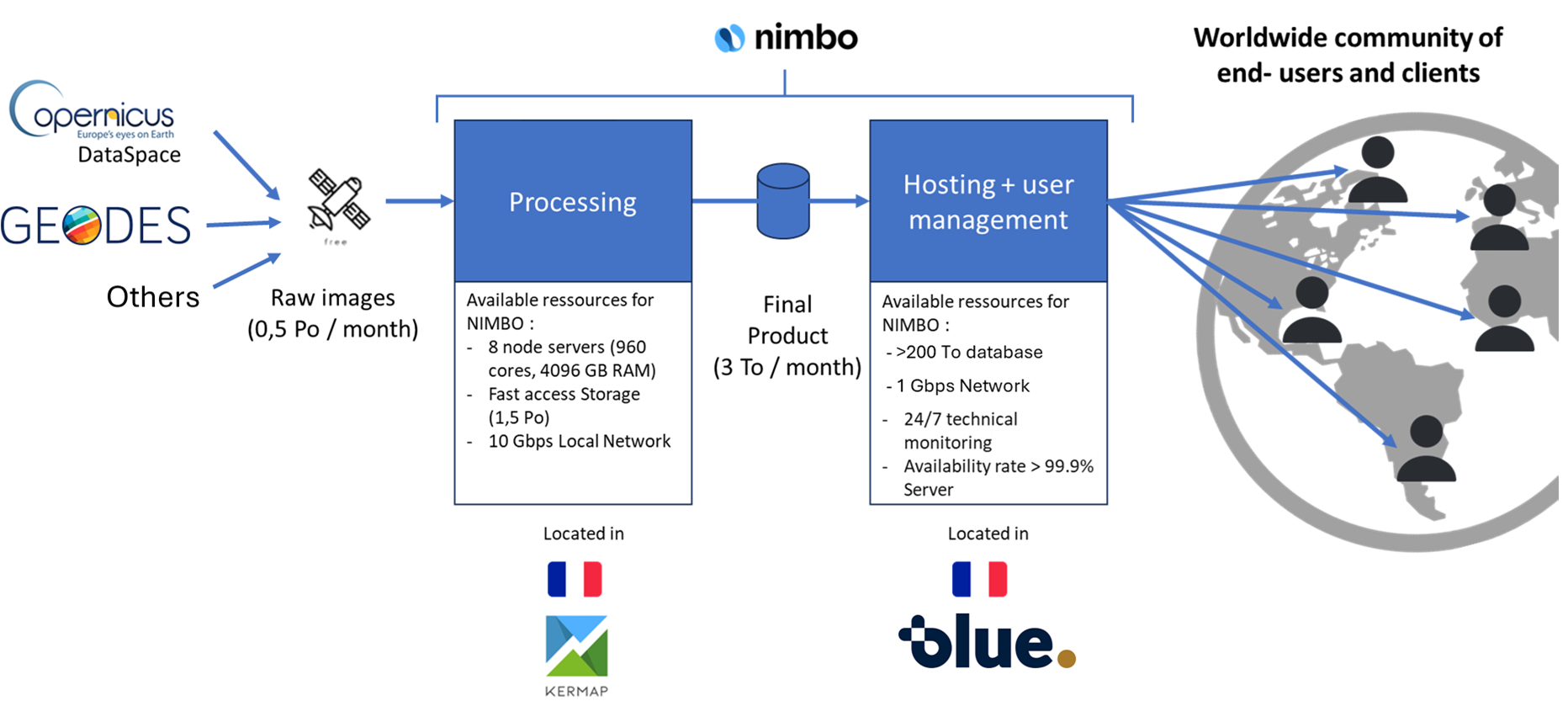
When we designed Nimbo, we made a deliberate choice not to rely on Hyperscalers (AWS, Microsoft Azure, Google Cloud Platform).
The technology isn’t the problem. We walked away because their business model imposes an external logic on your product. Pricing models, data egress costs, and strategic dependencies are all decided elsewhere and can change without notice.
Instead, we chose to build and operate our own independent infrastructure in partnership with BT Blue, a Tier III+ certified sovereign operator based in Brittany, France. This meant deploying dedicated physical servers and administering them directly. It also meant taking on responsibilities that many startups prefer to outsource including hardware lifecycle management, security hardening, and redundancy planning.
This choice had a cost. It was slower to implement and required capital investment at a stage where renting cloud resources would have been easier. But it fundamentally refined the nature of the service we could provide. It ensured that the keys to the infrastructure never leave our hands. Our users are never at the mercy of the shifting priorities of tech giants or the volatility of global politics.
Owning the satellite imagery processing chain
Sovereignty does not stop at hosting. It must be secured in production.
At Nimbo, all satellite mosaics are produced using proprietary AI pipelines developed and operated entirely in France. We work directly with raw Sentinel-2 data from the European Copernicus programme to create monthly, cloud-free, analysis-ready mosaics.
This approach allows us to solve the most difficult technical problems. In tropical regions, for instance, persistent cloud cover is the norm rather than an exception. Traditional compositing methods often fail, leaving large areas unusable for months. We built our AI processes specifically to recover usable information in these conditions. This is a prerequisite for operational monitoring, not a cosmetic improvement.
We also use super-resolution techniques to enhance standard 10m imagery to 2.5m per pixel. This is a practical choice rather than a theoretical one. The goal is to detect subtle disturbances like small clearings, new paths, or early signs of degradation before they evolve into large-scale damage. We sharpen the view without compromising the physical integrity of the data.
Temporal reliability is just as critical. In a Nimbo monthly mosaic, every pixel belongs to that specific month. This consistency may sound trivial, but it is what makes long-term monitoring and auditing possible. Without it, visual analysis becomes misleading and trust disappears quickly.
This is the boundary between a black box and a sovereign platform.
Popular platforms like Google Earth have changed how we see the planet, but they lack the accountability needed for professional work. Their imagery is often a mix of multiple sources and dates. Sometimes, a zoom level can silently change the season you are looking at.
For critical infrastructure, energy assets, or environmental compliance, this lack of provenance is a serious liability. Analysts should spend their time interpreting changes on the ground, not questioning the origin of the imagery.
Nimbo prioritizes consistency over spectacle. Every pixel has a known date, a traceable origin, and a clear place in time. This transparency allows satellite imagery to stand up to scrutiny, whether you are securing energy corridors, assessing mine rehabilitation in Australia, or validating carbon projects in Brazil.
Strategic resilience: sovereignty dictates operational continuity
Operating our own physical infrastructure solves a massive problem in the geospatial industry. Public cloud platforms charge steep egress fees just for moving large datasets. These costs scale rapidly and unpredictably. Because we own our hardware, our operating costs are fixed. We avoid exponential delivery fees entirely. This structural advantage is exactly what keeps our professional-grade data accessible.
But the real issue goes far beyond pricing. We built Nimbo because the infrastructure you rely on now dictates your long-term survival. The systems you build today must stay online tomorrow regardless of shifting international contracts, pricing strategies, or geopolitical decisions. Nimbo is a sovereign geospatial infrastructure designed to give professionals stable, affordable, and trustworthy access to the Earth’s surface.
If you want to explore satellite data that is built, hosted, and operated on solid ground, you can start today with Nimbo.